The ultimate food and wine guide to Provence
Food is the window into other cultures, and Provence’s cuisine highlights the region’s history as much as its terroir. Discover why food in Provence is so unique.

Sun-ripened fruit, fragrant herbs, rich olive oil, and Old World wine—Provence’s cuisine has a world-famous reputation for a reason. From Avignon’s quaint markets that sell fresh and local goods to sprawling vineyards that produce some of the globe’s most iconic wines (hello, Aix-en-Provence rose!) Provence’s signature ingredients each contribute to the region’s recipe for legendary-yet-approachable dishes. Here’s our guide to Provence’s best food, markets, and wine—and where you can taste them all on tour.
)
What is the cuisine of Provence known for?
Provence’s nutrient-rich terrain and year-round sunshine (with roughly 300 days of sun per year) make the region ripe for, well, ripe produce! Think: zucchini, eggplant, tomatoes, olives, pears, apricots, melons, and, of course, grapes—which means lots of wine, too. Beyond that, Provence is a honey-capital of the world, producing about 2,000 pounds of liquid gold yearly. Plus, the region’s proximity to the Mediterranean Sea means you can expect plenty of seafood.
The keywords when it comes to Provencal food? Fresh, local, and seasonal. Expect menus and Provence markets to vary with the time of year, and for every dish to be made of hyper-local and fresh ingredients, prepared in simple and rustic ways. It is, after all, a farming region surrounded by rolling vineyards, rows of lavender and poppy fields, sheep, and apiaries.
Learn more about Provence ➝

Classic Provencal dishes to try
In Provence, the preparation of food revolves around the freshness of the ingredients—which means seasonal, straightforward, and approachable meals. Provencal dishes differ from other French food cultures in that they rely more on ingredients than on preparation. Here are some of the best foods in Provence that you can try on tour.
Ratatouille. This summer stew is made with eggplant, zucchini, peppers, squash, tomatoes, and more. Its roots go all the way back to farmers in Nice, who used the last of their summer produce to make a hearty meal. Today, it’s a Provencal food staple and a perfect example of the region’s simple recipes.
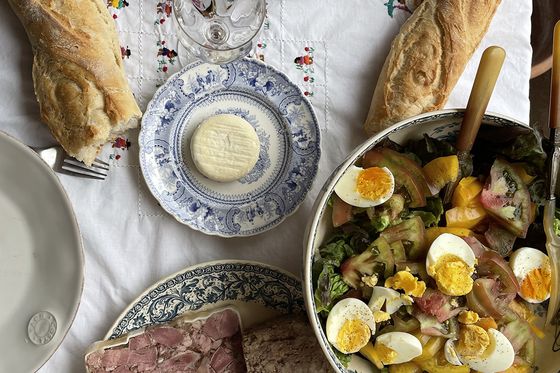
Grand aioli platters. Centered around homemade garlic aioli, these are perfect for grazing on during warm nights in Provence. While it’s really all about the sauce, aioli platters are served with a medley of veggies like potatoes, carrots, and cauliflower, as well as hard-boiled eggs and, of course, French bread.
Anchoiade. When in Provence, be sure to try this savory spread made from anchovies, garlic, capers, and vinegar with a hint of lemon—best enjoyed on (you guessed it) a slice of French bread.
Pissaladiere. This classic Provencal tart is reminiscent of pizza: crisp dough topped with sweet, caramelized onions and black olives or anchovies. It’s the perfect lunch, snack, or appetizer to enjoy during your South of France travel adventure.
Honey-based desserts. Try pain d’epices (a gingerbread made with honey and cinnamon), pear and honey tarts, and anything that combines honey with the local lavender on any of our Provence tours.

Provence’s essential ingredients
Warm, sunny days lend well to growing ingredients like herbs, olives, citrus, and lavender—and tasting all the fresh flavors is one of the best things to do in France. Here are some of the most notable flavors the region has to offer.
French olive oil. Provence’s olive oils tend to be mild, vegetal, soft, and even fruity compared to those of other countries and regions. Many of them are also AOP-certified, meaning they adhere to Appellation d’Origine Protegee or Protected Designation of Origin, and the growers produce the olive oil in designated regions using traditional methods.
Herbes de Provence. If you’ve ever spent time in the spice aisle at the grocery store, you’ve seen or maybe even purchased this blend of thyme, savory, marjoram, rosemary, oregano, and sometimes even lavender. The herbs grow plentifully in the Mediterranean region, and Provencal locals season everything from pasta to lamb to salads with the savory mix.
Garlic. We can’t discuss France’s food culture without talking about garlic! And Provence’s garlic is different than others: It’s sweet and subtle, absolutely delicious in an aioli.
Tomatoes. Provence’s tomatoes are some of its finest produce and are lauded for their wide variety of flavors. Both the moya and rose de Berne tomatoes are sweet and low-acid, while black krim is salty and even a little smoky. Our advice? Try them on your trip to Provence.
Menton lemons. You won’t be sad when life hands you these lemons. Expect a plump, sweet, and zesty citrus with a soft rind that’s also delicious.
Lavender. Perhaps what Provence is most known for, the purple flower thrives in the hot Mediterranean sun. Its uses range from soap to food, and you’ll find lavender in desserts and herb blends, and even in cocktails and coffee, too!
Honey. Like lavender, honey is plentiful in South of France travel. And like Provence’s wine, honey is a true reflection of the region’s terroir. Try different honeys and honey-based treats as you go, and you’ll notice the distinctions between regions—from more floral to more rustic notes and everything in bee-tween. (See what we did there?)

How Provence’s flavors shift through summer
The best time to visit Provence is definitely when you can eat your favorite food! Since ingredients vary by season, be sure to pay attention to what will be available when you plan your South of France travel. Here’s what you can expect based on the time of year you’re headed to Provence.
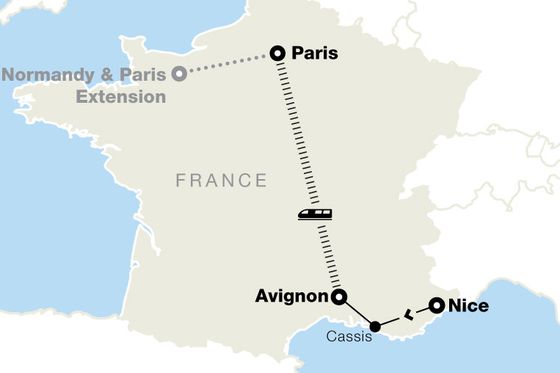
Early summer: Get excited for lavender honey, lavender pastries, and a fresh batch of herbes de Provence to take home. It’s a great time of year to join our A Week in France: The Riviera, Provence & Paris tour.
High summer: Provence markets will be bursting with tomatoes, melons, peaches, figs, zucchini blossoms, and more fresh produce. Join our French Riviera & Provence: Nice, Avignon & Aix-en-Provence tour between June and August to get more than a taste of Provence’s markets.
Late summer and fall: Olives, olives, and more olives. Taste fresh French olive oil, tapenade, and (one of our favorites!) olive oil cakes. Join our France for Solo Travelers: Paris, Provence & the Riviera tour during this time of year for the olive harvest and its tasty bounty.
Bon appetit in Provence

Provence wine: What to sip on during your South of France travels
We can’t go on about the cuisine of Provence without mentioning its world-famous wines, from roses to Chateauneuf‑du‑Pape. And what makes tasting them on tour one of the best things to do in France? Drinking local means Provence wines are that much more affordable when you’re visiting the region. Here’s what to know about the region’s varietals before you go.
Rose. Most of the roses coming out of Provence tend to be pale and fruity, but the region also produces juicier Coteaux d’Aix-en-Provence roses and more nuanced and layered roses from the Bandol region. Our advice? Don’t choose! Try them all on our 7-day France itinerary: A Week in France: The Riviera, Provence & Paris. Pair your rose with everything from a pear and honey tart to a fresh seafood pasta, or just a sunny day.
Cheteauneuf‑du‑Pape. This isn’t a grape; it’s a region, which means you can taste both red and white varietals, but there are no roses made here. Ancient river stones in the area add to a distinct terroir, and while more than 13 different grapes are grown and blended here, most Chateauneuf‑du‑Papes are grenache-heavy, making them juicy, big, and the perfect pairing for a lamb roasted with herbes de Provence. Taste your way through the famous wine region on our France for Solo Travelers: Paris, Provence & the Riviera tour.
Coteaux d’Aix‑en‑Provence. Try wine from this region on our Barcelona, Southern France & the Italian Riviera tour. The famous area is known for its juicy roses, complex reds, and aromatic whites. The roses go with anything made on a warm, peak-summer day, while the reds are better suited for chillier evenings spent digging into a ratatouille or roasted beef. Pair the whites (which are dominated by the vermentino grape) with seafood dishes and anything with lemon.

Where you’ll taste Provence’s flavors on tour
Hungry to find out where you can enjoy Provencal flavors in real life? Join us on our French Riviera & Provence: Nice, Avignon & Aix-en-Provence tour, and we’ll take you to all of the most iconic places to eat in Provence.
Dig into the foodie culture in Aix-en-Provence
Tour Senanque Abbey. First founded in 1148, its modest stone cloisters still house a community of Cistercian monks. Learn how they cultivate the fragrant (and photogenic) rows of lavender that greet visitors.
Visit an apiary. Enjoy a guided tour of the beekeeper center and sample some of its honeys from the source.
Taste French olive oil in Gordes. Known as one of “the most beautiful villages of France”, Gordes is an idyllic spot for any foodie to stop and take in the sights. Plus, we’ll take you to a family-owned olive mill to learn about their process and taste their olive oil.
Shop Provence’s markets. One of the many things that this region is known for is its farmer’s markets. Stroll through as many as you can, sampling local cheese, smelling lavender soaps and candles, and of course, securing as many bottles of local wine and herbes de Provence as you can carry!
Eat like an artist in the Camargue Region, where painters and writers have lived for centuries
Have lunch in Saintes-Maries-de-la-Mer. Get a taste for slow travel in this quaint fishing village that has inspired luminaries like Pablo Picasso and Ernest Hemingway. The cuisine is known for its shellfish and bull meat.
Buy wine in Arles. Admire Roman relics and the River Rhone before you grab a bottle of local wine (this area bridges the gap between the Southern Rhone Valley and Provencal wines). The reds are known for deep berry notes while the whites are citrusy and floral.
Taste ingredients grown from medieval soil on day trips from Avignon
Visit Uzes. This medieval town is ripe with local specialties and small producers of truffles, goat cheese, cod, and more. It’s also one of the villages that make Provence’s markets so famous, so don’t miss out when you’re there.
Add the Chateauneuf-du-Pape tasting and dinner excursion. Translating to “the Pope’s new castle,” this region became the summer residence of Pope John XXII in the 14th century. That meant the wine produced there was known as “the Pope’s wine,” securing it a notoriety that holds strong even today. Add our optional excursion to visit a wine cellar and sample several of the region’s most distinctive vintages before heading off to a local restaurant for a classic Provencal dinner.
Discover the five prettiest places to visit in Provence ➝

FAQs
Thea fell in love with travel as soon as she arrived in Venice, Italy on a family trip as a child. Since then, she has made having adventures around the world a priority, with trips like retracing her grandfather’s steps through WWII, climbing glaciers in Alaska, and horseback riding in Iceland. Thea is a nomad at heart, always planning the next trip. In her off-time she is working on a novel inspired by the woman she was named after, mixing cocktails, and watching any procedural crime show she can find.




)